
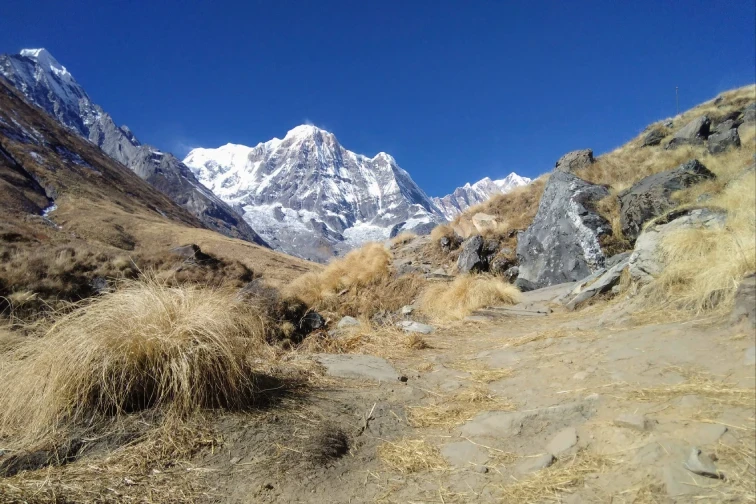
Winter trekking on the Annapurna Base Camp (ABC) is an other-worldly experience compared to trekking at different times of the year, as there are fewer people and pristine views of Annapurna I (8091m) and Machapuchhre; both composite and snow-covered. The ABC trek will take approximately 12 to 15 days to complete, starting from Pokhara and covering approximately 115 km (the trek starts from the village of Nayapul) and reaching an altitude of 4130 meters. Due to the cold weather and snowfall, trekkers need to prepare appropriately for this adventure, as temperatures will be below zero at times.
The ABC winter trek route will begin in Pokhara, and the route is taken with a focus on ascending gradually through lush, green rhododendron forests at lower altitudes, and then ascending to the upper elevations where the rhododendron trees are bare and skeletal-looking due to frost. Day 1 is a drive from Pokhara to Nayapul (1070 m), and then continue through the cold to Tikhedhunga or Ulleri (1960 m), where you can still see the first villages you'll pass through on your trek.
Days 2 and 3 are days of journey to Ghorepani (2750 m) and Poon Hill (3210 m), where you can enjoy incredible views of Dhaulagiri and Annapurna South during the sunrise, on snow-covered paths.
After visiting Poon Hill, the next stop on the trek is to descend to Tadapani, and then on to Chhomrong (2170 m), which is a hub for the Gurung people that has plenty of teahouses that serve warm dal bhat. After Chhomrong, the ascent continues to Sinuwa, and Bamboo (2310 m), which are located in denser forests, and where frozen streams will sparkle when the sun shines through; the ascent continues to Himalaya (2920 m) and then on to Deurali (3230 m) before you arrive at ABC sanctuary after visiting Machapuchhre Base Camp (3700 m), which is located in a natural bowl surrounded by peaks.The descent retraces the upward journey up to this point, but also diverges to take advantage of the hot springs at Jhinu Danda before arriving at Nayapul and Pokhara.
During the winter months, weather conditions significantly affect the route: The snowpack significantly increases above Deurali, and icy spots form that require caution; however, portions below Deurali remain hikeable with limited hazards. Total Elevation Gain: 3,000m (spread over multiple days in order to prevent AMS).
At this time, the following weather patterns may be observed in ABC during the winter months: extremely cold temperatures (0-5 degrees Celsius during the daytime at basecamp, down to minus 15 degrees Celsius at night) with regular snowfall above 3,000m, very low temperatures (minus 10 degrees Celsius to minus 20 degrees Celsius) in January with minimal snowfall due to drier air resulting in fewer storms, and increased risk of frostbite on exposed trails; February offers marginally higher temperatures during the day (5-15 degrees Celsius in lower valleys), and continued snowfall above Deurali creates stunning scenery but very slippery conditions.
The views from the summit of ABC are absolutely breathtaking, and as long as you have a good headlamp you will have a clear view of all points in the horizon (the sun will set early - approximately 5:15PM), so plan on getting an early start on your walking time. There are minor avalanche hazards at elevations above 3,000m, but all of the main routes to ABC can be safely traversed with the ongoing monitoring by guides. Therefore, when packing for ABC, be sure to pack for both extremes: in the lower valleys you can have daytime temps between 10-15 degrees Celsius, and in the higher camps, winds can chill to minus 20 degrees Celsius or lower.
Acclimatizing in Pokhara, having an Annapurna Conservation Area Permit (ACAP), and getting a Trekking Information Management System (TIMS) Card, all three of these things prior to starting your trip, will ensure your success on your ABC trek in Winter.
Start your trek early in the day and plan on finishing before sunset (when the sun goes down, have your headlamps ready to use); and eat a diet made up mostly of high-caloric value meals (ex, momos, and ginger tea) while you are trekking.
Trekking on the ABC trail in the winter means there will be fewer people on the trail allowing for more flexible pacing but it is very important to remain aware of the limits of your porters, especially when the temperatures are extremely low.
| Highlight | Winter Specialty | Best Time |
| Poon Hill Viewpoint | Crystal-clear dawn panoramas | Pre-sunrise, Dec-Feb |
| ABC Sanctuary | Snowy amphitheater immersion | Sunrise/sunset |
| Jhinu Hot Springs | Relaxing in natural pools | Post-trek relaxation |
| Chhomrong Village | Gurung culture, valley vistas | Mid-trek evenings |
Besides the basics, winter requires thermals, down jackets, and vapor-barrier liners for boots. First-aid kits include blister kits, ibuprofen, and altitude medications, while satellite communicators bridge network gaps. Teahouse menus shrink, so stash energy bars, nuts, and chocolate.
Safety depends on weather forecasts-apps or guides predict snow; no solo treks in established crevasse zones. Insurance for heli-evacuation until over 4,000 meters is absolutely mandatory.
Annapurna Base Camp in winter captivates with its snow-blanketed trails, crystalline skies, and unobstructed Himalayan panoramas, offering trekkers a profound sense of solitude amid towering peaks like Annapurna I and Machapuchhre. This off-season gem rewards the prepared with magical sunrises over Poon Hill, steaming hot springs at Jhinu Danda, and cultural warmth from Gurung villages, all while demanding respect for sub-zero chills and icy paths.
Conquer this icy adventure safely by partnering with Miracle Treks, whose expert guides, winter gear, and tailored itineraries ensure seamless navigation and unforgettable memories. Ready to embrace the winter wonder? Book your Annapurna Base Camp trek with Miracle Treks today at thirdeyeadventure.com and step into Himalayan magic.
Yes, with proper preparation, experienced guides, and gear like crampons and warm layers, winter ABC remains safe despite snow and cold; main risks like avalanches are minimal on core routes.
December to February offers clear skies and fewer crowds, with December ideal for moderate snow and February for thawing paths, though nights drop to -15°C or lower.
Highly recommended—guides from agencies like Miracle Treks navigate ice, monitor weather, and handle permits for safer, smoother treks.
